A Few Drams on Raasay and a quick hello to Skye: Scotland Reflections Part 5

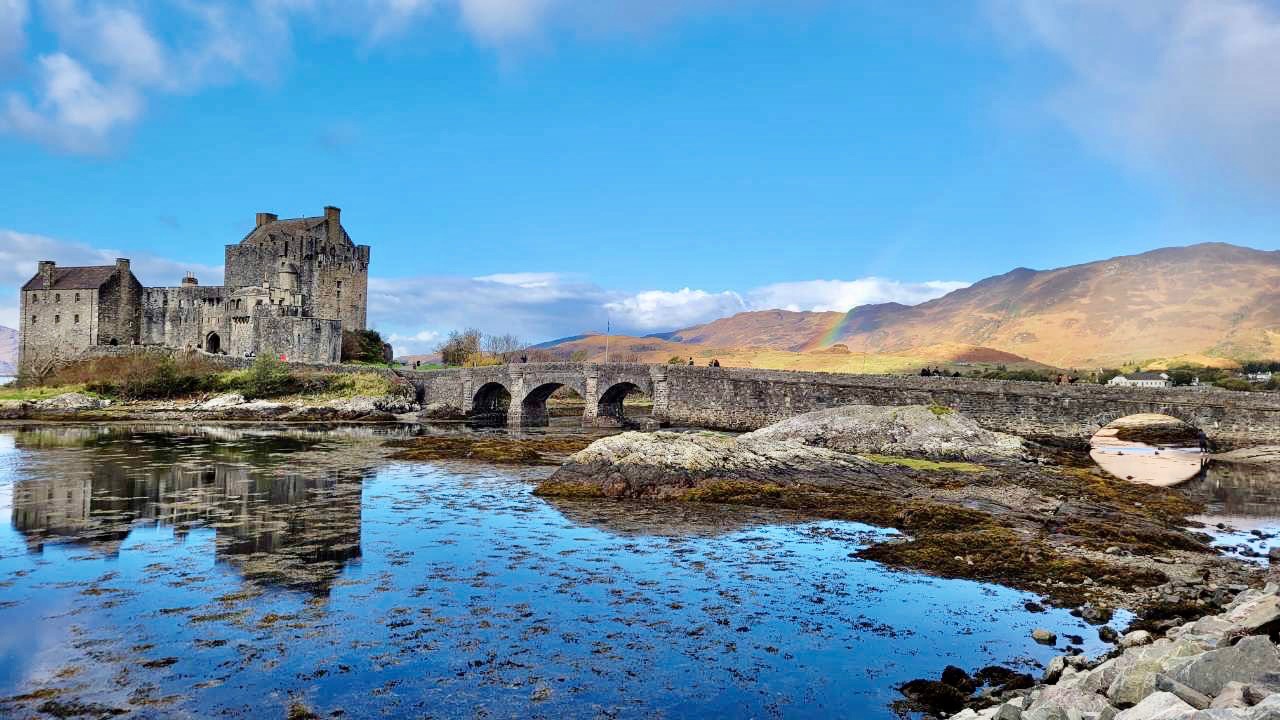
Onward west we ventured. A spectacular drive from the Glencoe region toward the Isle of Skye brought us to Eilean Donan Castle, which sits at a meeting point between three lochs. This restored castle was one of the most frequently found instagram tags when I began researching our itinerary. Generally, we find ourselves going in the opposite directions of the most trendy stops, however this spot has some well deserved clout.

While this castle stood in ruin for the better part of the last few centuries, it was purchased by Lt John McCrae in 1911 and lovingly restored based on surviving ground plans from it’s long history. The island of Donan, where the current structure sits, dates back to the 6th century where a chapel was believed to originally reside. In the 12th century (or so) the first castle was erected, by the late 13th century the castle held by the Mackenzies, and in the 14th century the MaCrae’s garrison on and off on behalf of the Mackenzie chiefs. In the 1700s, 300 spanish troups resided in the castle after landing in support of the Jacobites. This lead to the government of the time taking the castle down to ruins, which is how it sat until Lt John MaCrae and his subsequent decendants began the journey to restoration. Today it sits as a living museum to times past and has been used in numerous films. This was a well invested admittance fee!
After our break touring the castle and grounds, we continued west over to the Isle of Skye to await our first ferry of the trip.

Let me tell you how much I stressed about ferry trips. Once we landed in Scotland, and began feeling out the nature of some of the planned on trips on ferries, we actually rearranged a big chunk of our trip to avoid a few crossings due to local news and unpredictable seasonal weather. In the long run, I was so glad we did this. And, our first trip – just 25min from Skye to the Isle of Raasay (Island of the Red Deer)- was quite seamless, much anticipatory stress aside.

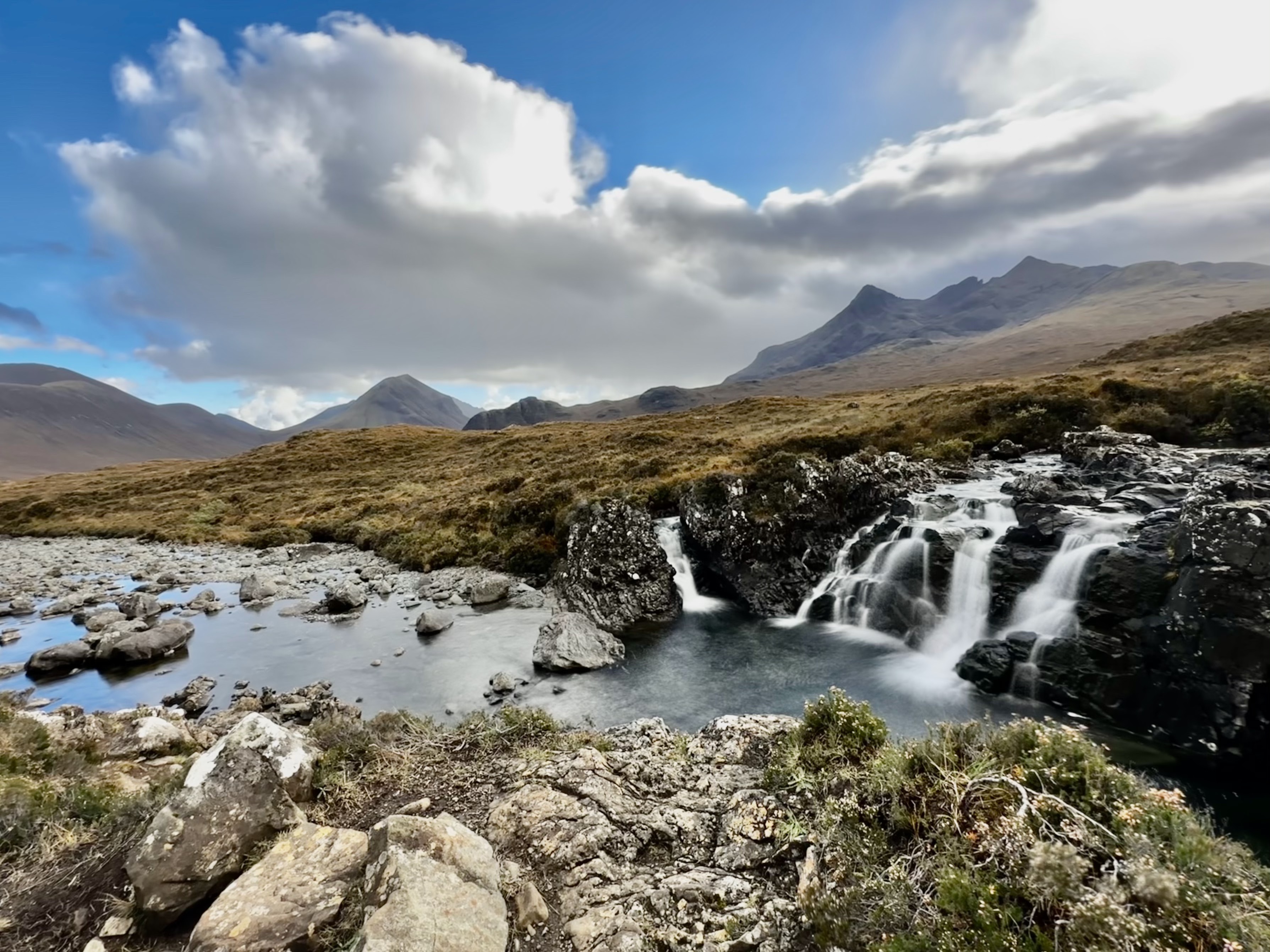
Because we arrived obnoxiously early for our ferry (see above anxiety), we had time for a mystical little hike in the Skeabost Bridge area of Isle of Skye. There is a rumour in the area that if you place your face in the icy cold waters of the stream here you will be granted timeless beauty. Neither of us felt the need to do this, but we did enjoy the fairy realm like scenery, rainbows and crisp fresh air nonetheless.
After our short ferry ride that evening we arrived on the Isle of Raasay. We had booked a stay at the Raasay Distillery, a new and modern whisky and gin distillery on a very small island. One of our higher investment stays of the trip, Raasay was well worth it. The distillery hosts a very small Inn onsite, all modern and well attended by excellent staff. We were greeted with a few drams, set up in our room upstairs (which came with a bottle of complimentary Whisky) and then left to watch the moon rise over the mountains visible across the way on Skye while enjoying a few more drams before dinner in the Distillery’s restaurant (as award winning as the Distillery itself). The whisky, food and company was wonderful and I remember sleeping very well that night!

The next morning we awoke to breakfast in the hotel while watching a whale surf through the bay and then a distillery tour. This is where we began to appreciate Scottish gin is often just as good as their whisky. We also were impressed to hear about how this Distillery is working to revive the island’s way of life within their growth. The Raasay Distillery employs about 30% of the island’s population, with priority placed on hiring those who have roots in the Island and either already reside there or were willing to move back. They source their water from a well on the island that is supplied by rain water, and source everything else they possibly can on the island or as immediately locally as possible. Beyond this, they also return their used bran back to local farmers to use for livestock feed at no cost to the farmer other than picking up.

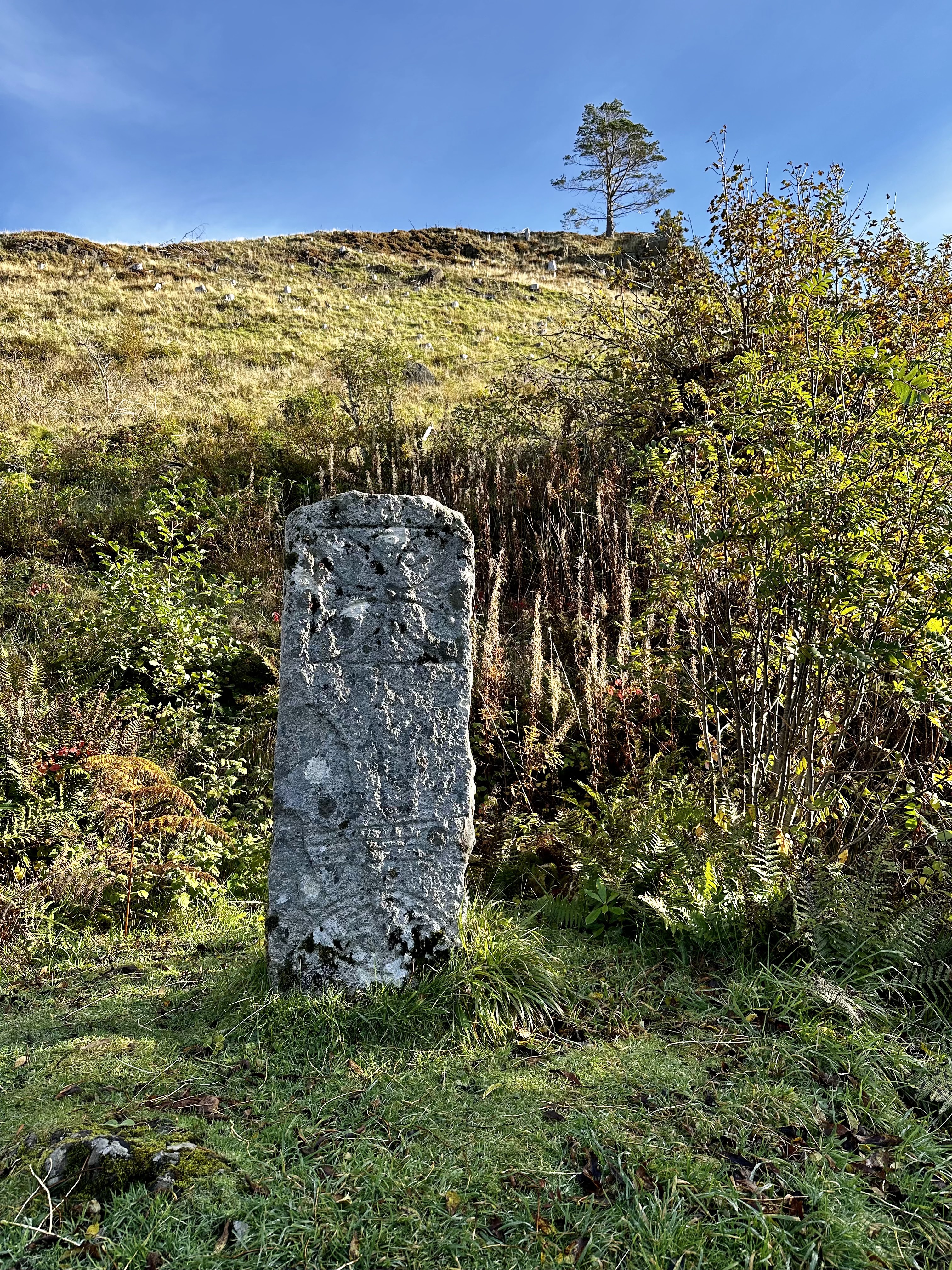
After this enlightening tour, we were tasked with waiting for our ferry back to Skye. Slightly more relaxed this time, we visited a Pictish Stone that sits on the Isle of Raasay.
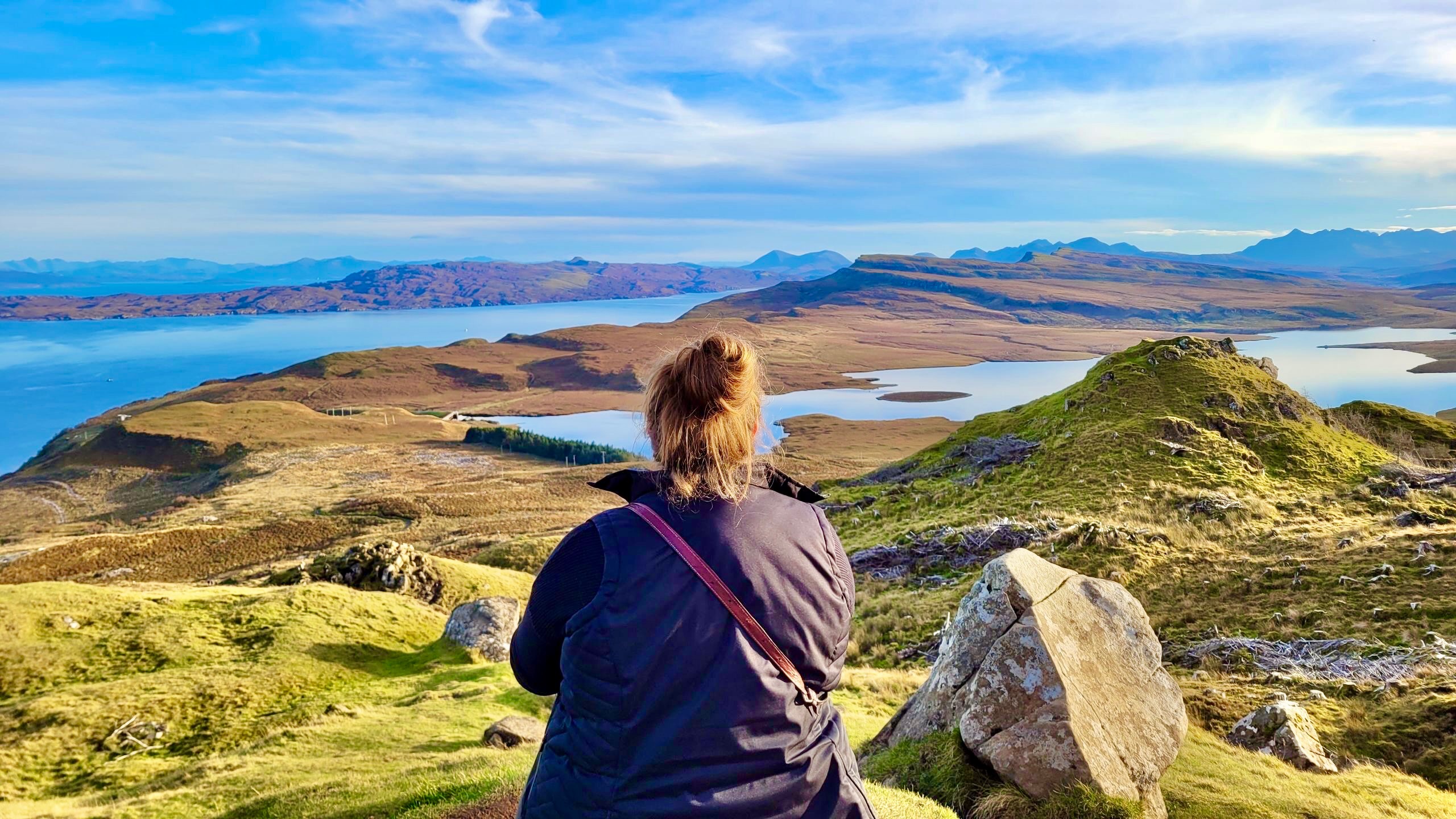
Once back on Skye we drove towards Portree (pronounced Port Rhyee) and decided (aka Garrett decided, I was a little too hungover to argue) to hike up to Old Man of Storr. It was a big of a push up on the steady incline to some well worth it views.
We lucked into dinner in Portree shortly after (as it turns out, Portree is definitely a town to make reservations in advance in.. even in the shoulder season, we had to do quite a bit of maneuvering and lean on some luck to find a place to take us for dinner) and then found our airbnb to settle in for the evening. We wound down watching the moon rise again over the rolling, dark hills in our part of Skye.

That night I dreamt I was a time traveller. I was looking at some pretty silver rings with celtic designed carved into them. As I put one onto my finger, there was a big flash of light and I woke up to our next day on Skye.

We took a back road, mountain pass across the island to Bog Myrtle Cafe – a delightful aesthetic of vintage books, art and furniture with strong espresso. After breakfast we continued up the coast line to the Fairy Glen for a walkabout (another well versed spot on the instagram tourist plugs). From here we continued onwards up to Duntulm Castle ruins that watch over the sea. The monument to this castle reads: “the world may end, but music and love endure”. What a message to stumble on at what feels like the edge of a world.

Continuing down the coast from this tip of Skye we wandered Brothers Point before finding our next dinner stop, “Old School Restaurant”, the name describes the venue. The dinner service was wonderful, with a big old wood stove to warm us up.
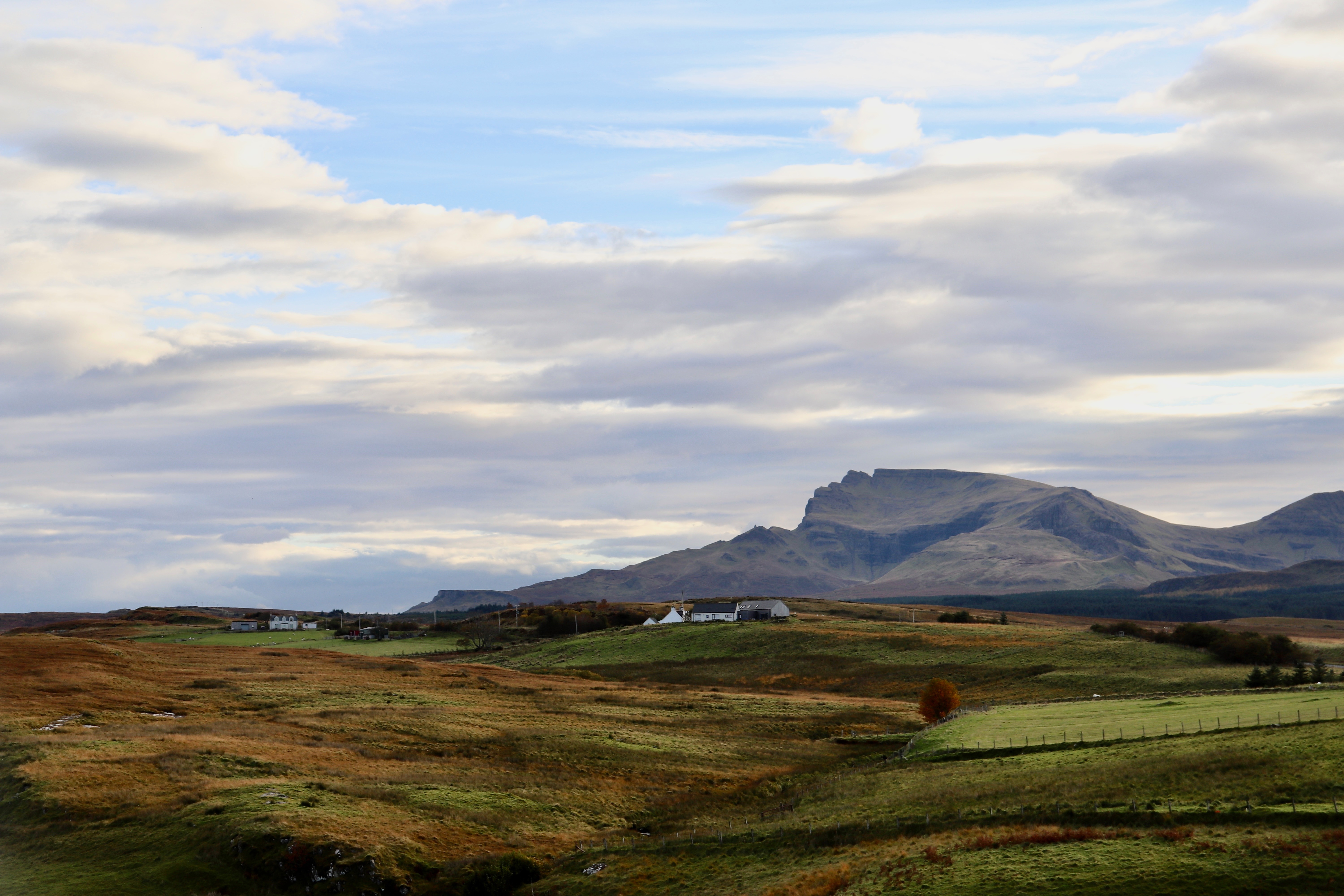
While I was glad we included Skye on our visit, having been there I’m not sure I would stress about going back. It is certainly one of THE destinations for most tourists in Scotland, and though we were there in shoulder season so likely dodged the bulk of congestion, the area to me felt fatigued. Mystical and wonderful, and yet somehow tired. I wrote lots about feeling tired, excessively so, while there. Was that a dram too many at the distillery that kicked off our stay in the area? Perhaps. Could it also have been an area well worn by tourists boots and the clicks of cameras?

This may not click with all who read this, but as someone who is becoming attuned to the whispers of land across many timelines, Skye was an interesting place to be received but almost in a despondent way. I’ve been to places that hold a tune of “thank goodness you came to visit” enthusiam, and with the grain of salt that may be a mild hangover after the chest cold that came with Edinburgh, Skye seemed to say “thanks for stopping by but I’m really a bit busy” with the door already half closed. This isn’t to say anything negative about the hospitality to be found on the island, more to speak to the energy of the landscapes we found ourself wandering through.

I was glad to have been and ready to leave. From Skye we began our trip further up the west coast, to a land more rugged and almost alien in it’s scenery. Think purple skies, molten rocks, pink beaches, untamed orange grasses and rogue sheep. More on that next time.
On the backs of dragons: Scotland Reflections 1, Edinburgh

As spring arrives I am in some ways still steeping in the intensity of last year: one of my busiest professional years yet, getting married in September and then spending a month overseas in Scotland on our honeymoon.

I’ve always found that travel is best processed in hindsight. All the experiences over the year, culminating in our travel in the fall, very much seem to have neatly encapsulated a transition point in my life. Perhaps a writing exercise for another time, or over this series of reflections, is my own ongoing embodiment of that transition. I haven’t quite found my language for it yet. I remember when I first tried on my wedding dress, there was a surprising feeling of not recognizing myself. Seeing instead who I was becoming, and what embodiment I was just stepping into.

That feeling continued as I moved through the year leading up to our wedding. In some ways I linked it to an initiation of sorts. To what, I’m not sure. There’s a level of maiden in many ways I stepped out of, but I don’t quite identify with the traditional “mother” phase heading towards crone in common spiritual language. What replaces mother in modern day life when “mothering” isn’t the calling?

Even now, as I work on my herbalism thesis (which I should be working on now, but when creativity calls, it calls), which focuses on integrative herbalism in the treatment of modern day cyclical health (women’s health); I am faced with that same question. For those of us who are consciously choosing to not have children, existing within a healthcare and wellness care system that hinge fertility as the deciding factor around health, much of the time, how do we support vitality while linking a woman’s value to more than just their ability to bear life into the world?

Around this same time, in the midst of wedding planning and facing all the micro transitions along the way to our wedding, we began to figure out where we wanted to travel to afterwards. Both G and I have always been interested in Scotland, and it was in with a few other options for our honeymoon. For me, Scotland has many ancestral ties. I knew whenever I did get there, there would be many explorations in real time as well as otherwise that would occur. In hindsight, it seems more and more appropriate that the energetic “homing beacon” began to chime in as this being where we headed to on our first trip as a married couple.

Our first stop on our trip was Edinburgh. It was a relatively short flight across the pond from Toronto, and after a brisk jog through the Toronto airport due to a delayed incoming flight – we settled into the overseas flight. As I tried to sleep, I was washed over with memories of my maternal grandparents. Specifically, the home of theirs that I spent lots of time at. Memories of summers spent in the back yard, with cousins, running through the garden. The feeling of running through the corn in the garden. Picking peas and carrots. The smell of their garage. I wondered if my grandparents had ever explored some of the territory I was about to explore. I had the sense they were along for the ride with me. Likewise with my paternal grandparents. What ancestral memories would I find, and what questions would I answer? I also had the sense that this was firmly my journey. I remember thinking, I am creating my own memories on the foundations of the past. Perhaps it was the half asleep and already sleep deprived vision taking hold, but as we approached EDI in the very early hours of the morning, it appeared to me that there were black dragons flying alongside our plane. Some guides for the journey ahead, perhaps.

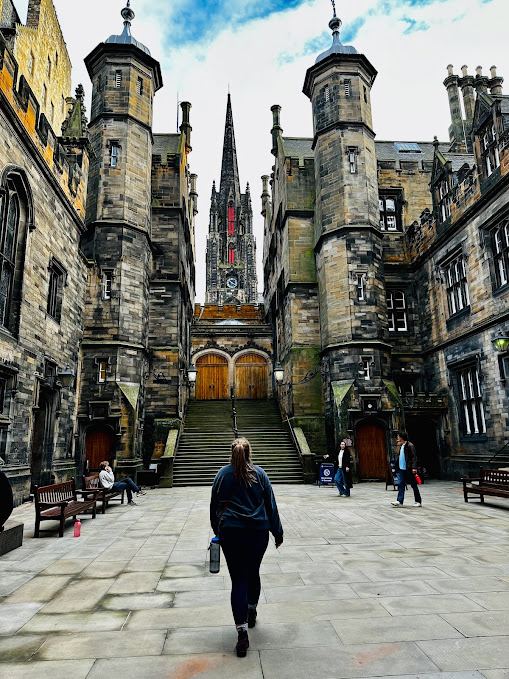
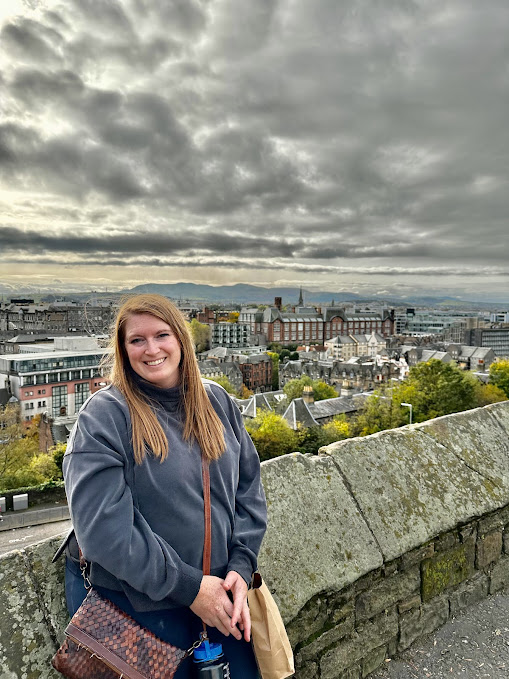
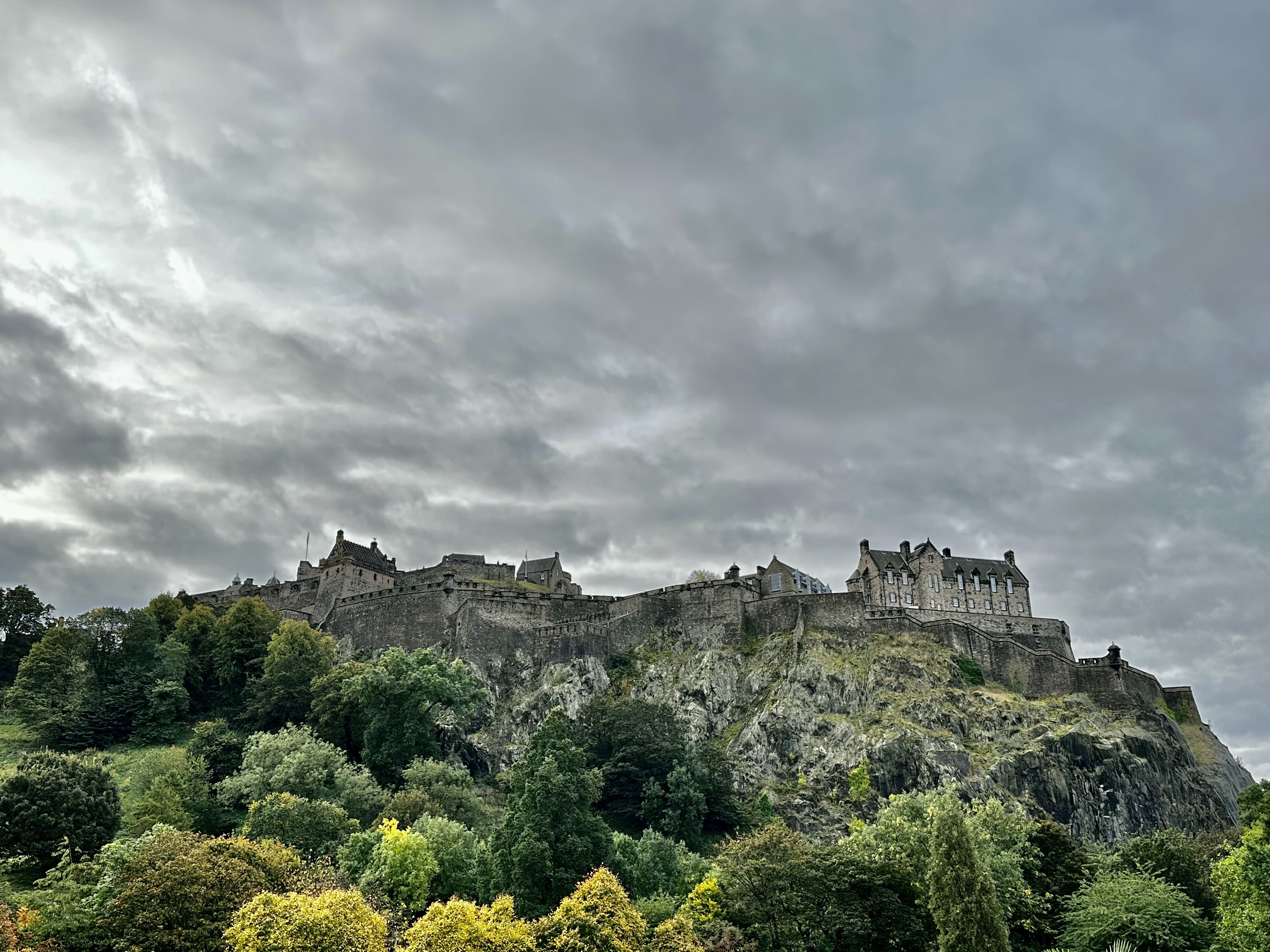
We landed at 6:30am on Oct 17th. Our first orders of business were cappuccinos in an airport cafe while setting up our SIM in my phone and getting a handle on the bus system that we’d be using while in Edinburgh for a couple days. We took our first double decker bus from the airport to our BNB, which was just outside of the downtown area of EDI. Our hosts were gracious enough to let us move in that morning, the day of our check in, and even insisted on cooking us breakfast. Much appreciated way to start our first day. In a brave attempt to mitigate the worst of the time change, we had a strong intention to use the day to explore the city and stay awake. Which, we did indeed. Another bus, and 17,000 steps later we had seen much of Old Town on our first day. As we stepped off our bus into the city centre on Princes Street, facing the gardens with Edinburgh Castle looking down at us from the top of the city, it was one of a handful of experiences I’ve had of my breath being taken away completely.

Edinburgh is a very aesthetically pleasing city. Old town has been essentially the same for a few centuries now, and runs from the coast up the molten rock hill to peak with the castle at the highest point. New town has been essentially the same for the last couple centuries, and sits below Old Town. Remove the cars and street lights, and you could very easily be standing in the 1700 or 1800s. Though, a thought I had many times while we were in the city, the air quality may have been significantly worse back then. At one point, Edinburgh was considered Europe’s most population dense city. Multiple-story buildings were common in the 16th century and by the 18th century, buildings on High Street were often six to ten stories tall and could reach up to 14 stories towards the back where the land sloped down. The city was supplied with water via street level wells from the 16th century to the early 19th century, when slowly more modern plumbing became possible. Those living on higher floors (usually the wealthy), had to hire water caddies to trek water up the stairs until late 19th century. In 1797, the “Nastiness” Act was passed, which prohibited the tossing of waste out windows during daytime hours. Sanitation was a major issue in Old Town, along the Royal mile, until the late 19th century at least. Edinburgh would have been breathtaking for different reasons until very recent history.

We took in much of the Royal Mile on our first day, breaking in our travel legs well. We visited Greyfriar’s Kirk Graveyard (featuring many Harry Potter film graves, and much history) where G was shadowed by what seemed like a spirit dog. Perhap Greyfriar’s Bobby himself. We wandered up Victoria Street, the inspiration for Diagon Alley, popped into Napier’s, a herbal store that has been around since 1860, and then trekked back up the Royal Mile to the castle.

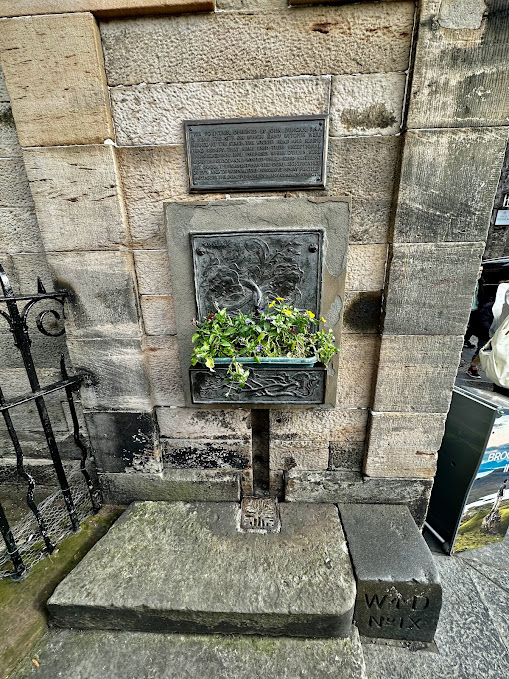
Along the way I found The Witch’s Fountain, tucked around the corner from the busy thoroughfare at the entrance to Edinburgh Castle. You have to know where to look to find this somewhat controversial monument, luckily I had done some research prior to our trip so I did know how to find it.

The Witch’s Fountain was created to remember the many women who were accused, tortured and convicted (commonly without fair trial), and publicaly executed for “witchcraft” – a label of convenience as we now know. The controversy behind this memorial is in the wording. The language on the plaque implies that the women being remembered were guilty, which as modern history shows, was never proven. The assumption that the women accused and forced to bear a horrible end to their lives, and the long history of persecution in other ways since, risks perpetuating harmful rhetoric. The debate, I suppose, is if remembering is still more valuable than forgetting.

By the end of our explorations on this first day, we were both nearly delirious from sleep deprivation. We somehow managed to find some fish and chips on our way back to our bnb, before hitting our bed pretty hard for a good night’s sleep.

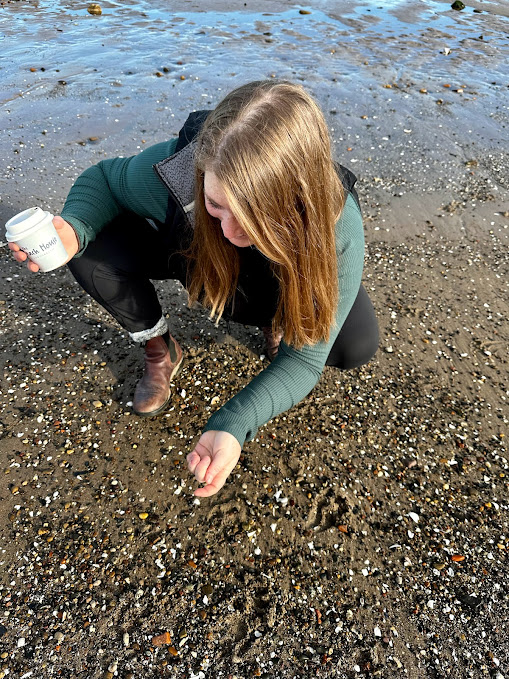
On our second day, we woke up to a lovely view from our bedroom window of the mist rising up over Arthur’s Seat after a 12hr sleep. With our coherency restored, and a little in need of a break from the congestion of city central, we took the bus out to the coast and found Portobello Beach. We grabbed a couple flat whites at a beachside cafe, and walked the beach in low tide. I spent most of that time finding stones and shells in the sand. The whole vibe reminded me of a book from childhood, Kate’s Castle. Here I was creating a realtime adventure in a land full of history and adventure, little imagination needed. With some time to spare, we continued walking along the beach, before finding a bus to catch over to a nearby neighbourhood that housed the Royal Yacht Britannia. After finding it behind a paywall, we decided to carry on back to Old Town where we had a tour of the underground vaults to take in.

Edinburgh didn’t only grow upwards, it also expanded underground. Largely due to lack of real estate, underground bridges and vaults were created. At first for businesses such as taverns, cobblers and storage centres. This relatively quickly devolved into low-no income living situation and illegal business. The vaults are as you’d imagine, dark, cave like carve outs in the rock foundations of the city. We toured the South Bridge Vaults, completed in 1788. Rumours suggest that during the illegal use era you could find rebel distilleries, bodysnatchers storing their latest digs (steeling bodies from graves to sell to researchers was a common, and lucrative, practice in the 18th-19th centuries as medical research grew but religious institutions outlawed studies on cadavers), and many unfortunate families making home in small caverns. Ventilation would have been non-existent and air quality just as bad if not worse as above ground. By the 1860s the vaults were believed to be emptied, though they were not discovered until the 1980s during excavation for building updates above ground. Now they are largely tourist attractions.

To cap off our final day in EDI, we found a bite to eat in Old Town before making our way back to our BNB and preparing to leave the city the next morning.

As awestruck as I was at first in EDI, I left feeling ready to leave. I was struck by what would have frankly been a horrible place to live historically, as magical as it seems today. Perhaps that lived experience was a past life experience I’ve had, as I couldn’t seem to separate the past from the present. As I began to steep myself in the history of my bloodlines, the idea of being faced with leaving rural settlements as the elite cleared space for sheep and given the option of city centres like EDI or getting on a ship, it was an interesting reflection as to what would be more appealing. Edinburgh is full of history, a centre of amazing scientific and medical progress, the inspiration for much creative works and novel thinking – and yet, I sensed so much turmoil, congestion and heaviness in the air still. I’m glad we went, and I was glad to turn our gaze towards route out.

More to come.